
Technology
CaptSure™ Is A Proven Platform Technology Amenable To Multiplexing
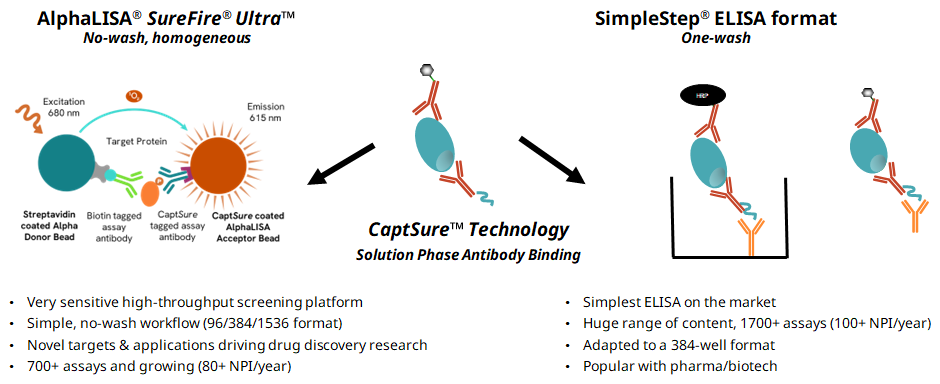
To translate the benefits of CaptSure™ to detection of multiple analytes in individual samples, TGR has expanded its platform with the development of multiple (10) new CaptSure™ anti-peptide antibodies. Each monoclonal CaptSure™ antibody in the CaptSure™ Multiplex system binds a specific peptide that is covalently attached to the primary assay antibody of choice. This allows differential immuno-capture of selected assay targets, providing multiplexing with generic assay system benefits.

CaptSure™ ELISA Overview
TGR’s CaptSure™ ELISA system delivers a quantum-shift in the way an ELISA, the workhorse of many cell-biology labs, can be run. A sample of interest (e.g. cell lysate, serum, conditioned media etc) is simply mixed with assay reagents, incubated in a CaptSure™ microplate, washed and incubated with substrate. The whole process can take as little as an hour, with far fewer handling steps than a conventional ELISA format. Abcam have built a huge catalogue (> 1300) of SimpleStep ELISA products on CaptSure™ making use of their own high quality RabMabs portfolio. Key CaptSure™ ELISA attributes: • Sensitive – for challenging biology • Fast – results in as little as 1 hour • Simple protocol – easy to run • Quantitative – for greater reliability • Flexible – measure multiple analytes on the same plate • Uses most plate readers – colorimetric readout
AlphaLISA® SureFire® Ultra™
In association with Revvity, TGR BioSciences’ flagship assay product, AlphaLISA® SureFire® Ultra™ caters primarily for the demanding needs of pharma/biotech in drug discovery. SureFire® is an innovative immunoassay technology platform that addresses complex cell signalling biology. Our extensive offering of > 500 ‘Phospho’ and ‘Total’ protein assays are pivotal to the characterization of various cellular processes and disease states and their reliable and sensitive detection helps to advance both drug discovery and basic research.

SureFire Assay Principle
AlphaLISA® SureFire® Ultra™ assay kits allow the rapid, sensitive and quantitative detection of phosphoproteins from cells. The kits utilize Alpha Beads that are each coated to specifically capture one of the assay antibodies. The Donor Bead is coated with streptavidin to capture the biotinylated antibody while the Acceptor Bead is coated with a proprietary “CaptSure™” antibody that immobilizes the other antibody which is labeled with a CaptSure™ tag. In the presence of a target protein (i.e. phosphoprotein in schematic below), the two antibodies bring the Donor and Acceptor Beads in close proximity, enabling the generation of an Alpha signal upon illumination of Donor beads by an Alpha-enabled plate reader (see below). The amount of light emission is directly proportional to the quantity of phosphoprotein present in the sample.
SureFire® Ternary Complex Assays are highly attractive for RIPTAC applications
TGR’s AlphaLISA™ SureFire® and CaptSure™ technologies provide a powerful new approach for studying RIPTAC-induced ternary complexes by combining rapid, sensitive, and quantitative protein-protein interaction detection with a simple no-wash workflow. Designed for high-throughput drug discovery applications, these assays enable direct measurement of ternary complex formation in native endogenous cell systems, removing the reliance on engineered or overexpressing cellular models and providing a more physiologically relevant view of RIPTAC induced biology.
Utilising multiple layers of IP, TGR has developed its first successful Target protein/ Effector protein (TP/EP) assays utilised by several pharmaceutical companies in their high throughput drug development screening programs.
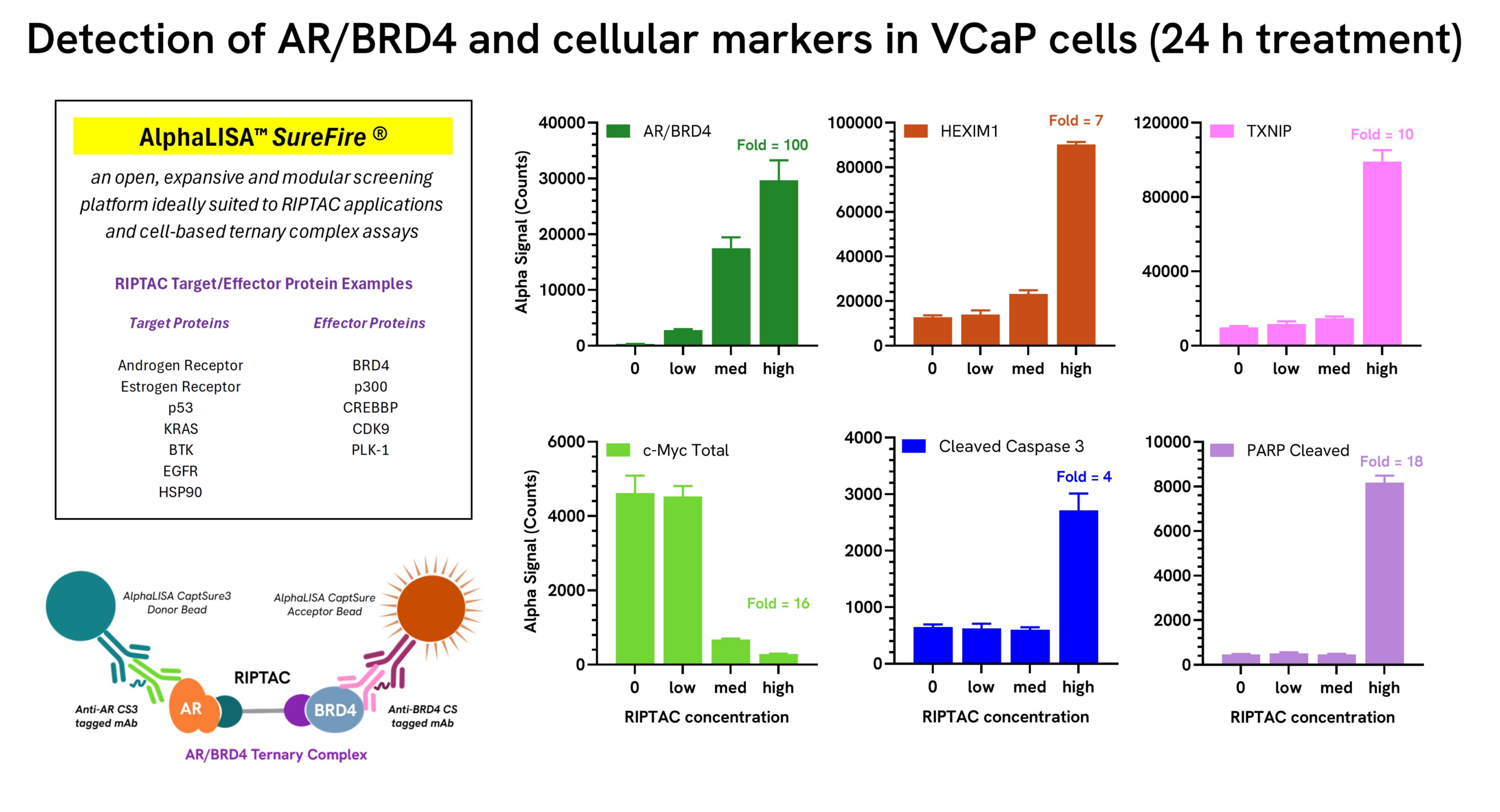
𝐀𝐑/𝐁𝐑𝐃4 𝐂𝐞𝐥𝐥𝐮𝐥𝐚𝐫 𝐓𝐞𝐫𝐧𝐚𝐫𝐲 𝐂𝐨𝐦𝐩𝐥𝐞𝐱
- 100+ fold 𝘼𝙍/𝘽𝙍𝘿4 𝙏𝙚𝙧𝙣𝙖𝙧𝙮 𝘾𝙤𝙢𝙥𝙡𝙚𝙭 𝘼𝙡𝙥𝙝𝙖 𝙎𝙪𝙧𝙚𝙁𝙞𝙧𝙚 signal windows in RIPTAC treated VCaP prostate cancer cells + profiling of cellular markers….all from a single lysate!
- Native 𝗲𝗻𝗱𝗼𝗴𝗲𝗻𝗼𝘂𝘀 biology.
• No reliance on engineered cell models.
• Significant downregulation of 𝗰-𝗠𝘆𝗰, upregulation of apoptotic (𝗖𝗹𝗲𝗮𝘃𝗲𝗱 𝗣𝗔𝗥𝗣 & 𝗖𝗹𝗲𝗮𝘃𝗲𝗱 𝗖𝗮𝘀𝗽𝗮𝘀𝗲-𝟯) and stress (𝗛𝗘𝗫𝗜𝗠𝟭 & 𝗧𝗫𝗡𝗜𝗣) markers. - Significant downregulation of 𝗰-𝗠𝘆𝗰, upregulation of apoptotic (𝗖𝗹𝗲𝗮𝘃𝗲𝗱 𝗣𝗔𝗥𝗣 & 𝗖𝗹𝗲𝗮𝘃𝗲𝗱 𝗖𝗮𝘀𝗽𝗮𝘀𝗲-𝟯) and stress (𝗛𝗘𝗫𝗜𝗠𝟭 & 𝗧𝗫𝗡𝗜𝗣) markers.
ER/BRD4 Cellular Ternary Complex assay to be launched soon
With a catalogue of > 700 𝘼𝙡𝙥𝙝𝙖 𝙎𝙪𝙧𝙚𝙁𝙞𝙧𝙚 cell-based assays, an expansive amount of permutations exist for combining ‘𝗧𝗮𝗿𝗴𝗲𝘁’ and ‘𝗘𝗳𝗳𝗲𝗰𝘁𝗼𝗿’ protein antibodies from our existing portfolio to build new cellular 𝗧𝗲𝗿𝗻𝗮𝗿𝘆 𝗖𝗼𝗺𝗽𝗹𝗲𝘅 assays.
Alphabetical list of kits available, with Revvity website links below: Full catalog numbers available at: Alpha SureFire Ultra no-wash immunoassay catalog | Revvity
AlphaLISA® SureFire® Ultra™ assays utilize bead-based Alpha Technology and requires an Alpha Technology-compatible plate reader, such as Revvity’s EnVision® and Nexus® Multilabel Plate Readers. Alpha technology eliminates the need for laborious techniques, such as Western blotting or conventional ELISA. It is a homogeneous assay with no washing steps and this attribute combined with the short incubation times and excellent reproducibility (lower CV%) make it highly amenable to robotic automation and is the ‘go-to’ platform for pharm/biotech in drug discovery.
For information on the successful optimazation of AlphaLISA SureFire® Ultra assays, visit the following Revvity weblink below: https://www.revvity.com/content/alphalisa-surefire-ultra-ultimate-guide-successful-experiments
Alphabetical list of kits available, with Revvity website links below: Full catalog numbers available at: Alpha SureFire Ultra no-wash immunoassay catalog | Revvity
Phosphorylation & Functional Cellular Readouts
AlphaLISA® SureFire® Ultra has been designed to provide exceptional assay sensitivity and greatly enhanced signal windows for kinase screening programs. Measuring endogenous cellular phosphoproteins can now be achieved in all types of cellular extracts, including cultured cells, tissue lysates, and in samples containing high levels of antibodies. Such samples include those where antibody biotherapeutics are being tested for efficacy. In addition, the assays have extremely low background signals, allowing testing of very low levels of pathway activation. Combined with Revvity’s AlphaLISA® technology, the SureFire® assays provide unmatched performance for phosphoprotein detection.
PROTAC Technology & Targeted Protein Degradation
SureFire® assays are also highly suited to targeted protein degradation approaches with the emergence of PROTAC (PROteolysis TArgeting Chimera) technology in recent years. This enables researchers to combine the measurement of cellular ‘Total’ protein level changes induced by PROTAC degraders with the functional ‘Phospho’ readouts that SureFire® assays are highly renowned for.
Alpha SureFire® Ultra™ Multiplex
In association with Revvity, TGR more recently launched a multiplex range of products called Multiplex SureFire Ultra™ (MPSU) kits. These MPSU assays allow the rapid, sensitive, and quantitative detection of phosphoproteins from cells, combined with the measurement of the total amount of the same protein in the same well. This Alpha Multiplex measurement is achieved by the use of two Alpha Acceptor Beads that emit at distinct wavelengths (545 nm and 615 nm). The two distinct Alpha Acceptor Beads report their binding to a distinct antigen through their association with specific assay antibodies, as indicated below. The Alpha 615 (Europium) Acceptor bead is conjugated with the CaptSure™ antibody, and the anti-phospho target antibody binding this bead is tagged with the CaptSure™ peptide. The Alpha 545 (Terbium) Acceptor bead is coated with the CaptSure2™ antibody, which binds the CaptSure2 peptide-tagged anti-total target protein antibody. The Alpha Donor bead binds the biotinylated anti-total target protein antibody. The assay utilizes the bead-based Alpha Technology and requires an Alpha Technology-compatible plate reader capable of reading dual emission wavelengths. For more information about the AlphaPlex technology download the “AlphaPlex Quick Start Guide” and the “AlphaPlex Assay Development Guide” to find guidance about filters and mirrors selection, instrument protocol and channels crosstalk correction.
Full assay catalog listing is available at: www.revvity.com/category/alpha-surefire-kits
The Alpha 615 (Europium) Acceptor bead is conjugated with the CaptSure™ antibody, and the anti-phospho target antibody binding this bead is tagged with the CaptSure™ peptide. The Alpha 545 (Terbium) Acceptor bead is coated with the CaptSure2™ antibody, which binds the CaptSure2 peptide-tagged anti-total target protein antibody. The Alpha Donor bead binds the biotinylated anti-total target protein antibody.
The assay utilizes the bead-based Alpha Technology and requires an Alpha Technology-compatible plate reader capable of reading dual emission wavelengths. For more information about the AlphaPlex technology download the “AlphaPlex Quick Start Guide” and the “AlphaPlex Assay Development Guide” to find guidance about filters and mirrors selection, instrument protocol and channels crosstalk correction.
